










The growing impasse between the Provincial Executive and the Sangguniang Panlalawigan (SP) of Catanduanes is no longer a mere political disagreement—it is a governance failure with direct consequences on public welfare. The Constitution is clear: public office is a public trust (Article XI, Section 1). When institutions choose confrontation over coordination, the trust reposed by the people is compromised.
The Governor, as Chief Executive of the province, carries the constitutional and statutory duty to implement laws, ensure public safety, and respond swiftly to emergencies. Under the Local Government Code (RA 7160) and RA 10121, decisive action during disasters is not discretionary but mandatory. Executive leadership must prioritize timely execution of programs and lawful use of emergency powers, guided by good faith and public interest.
The Sangguniang Panlalawigan, on the other hand, is constitutionally bound to legislate—not obstruct. Its foremost obligation under Sections 318–323 of RA 7160 is the timely passage of the provincial budget. When legislative time and energy are diverted to political declarations while essential fiscal measures remain unresolved, the SP risks breaching its core mandate to sustain government operations and public services.
The Supreme Court has repeatedly ruled that legislative authority must be exercised in good faith and for public purpose. Political acts that do not advance governance but instead deepen institutional paralysis invite scrutiny under the doctrine of grave abuse of discretion. Legislative independence is not a license for political retaliation nor a shield for neglect of duty.
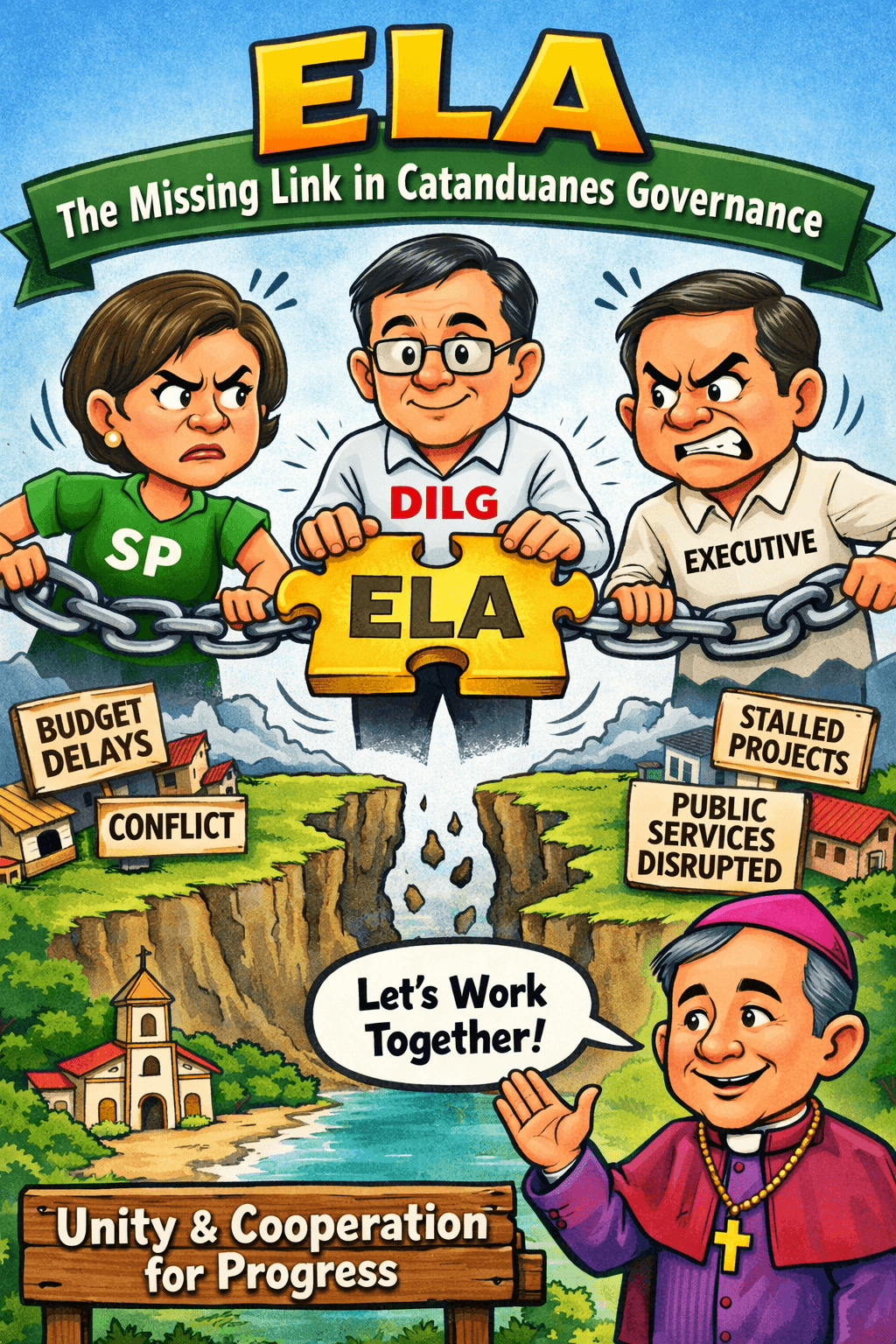
The absence of a duly formulated Executive and Legislative Agenda (ELA) exposes a shared accountability failure. The Governor is expected to initiate strategic planning, while the SP is expected to participate in and uphold it. The ELA is the lawful venue for reconciling priorities, aligning advocacies, and preventing policy deadlock. Ignoring this mechanism weakens both branches equally.
Budget delays, stalled projects, and delayed compensation are not abstract issues—they affect teachers, health workers, responders, and ordinary Catandunganons. As the Supreme Court has emphasized, public officials are accountable not only for illegal acts but also for conduct that betrays public confidence. Governance gridlock born of pride and politics falls squarely within that warning.
In a province repeatedly battered by typhoons, disunity is more than political irresponsibility—it is a governance risk. Disaster laws demand speed, coordination, and unity of command. Any official action or inaction that hinders timely response places lives and livelihoods in jeopardy and erodes the moral authority of leadership.
The call is neither partisan nor personal—it is constitutional. The Governor must lead with firmness anchored on law; the SP must legislate with discipline anchored on duty. Convene the ELA. Pass the budget on time. Respect institutional roles. Governance is not about who prevails in a standoff—it is about who stands for the people of Catanduanes when it matters most.