



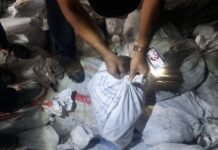







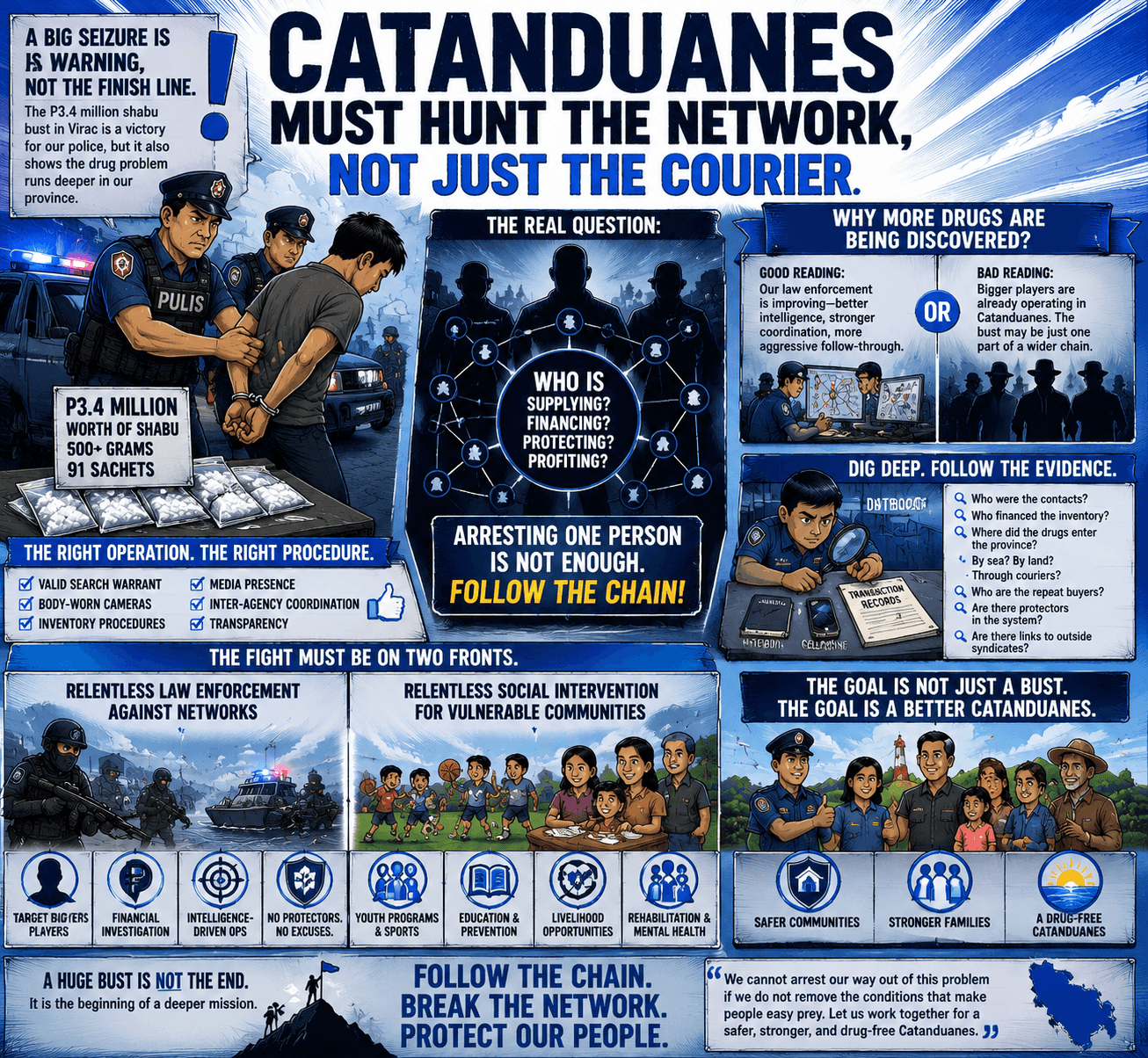
The seizure of P3.4 million worth of suspected shabu in Virac is, without question, a major operational victory for the Philippine National Police. It deserves recognition. A haul of more than 500 grams of suspected illegal drugs, packaged in 91 sachets, is not a small-time incident. It is a loud and disturbing signal. It tells us that illegal drugs are not merely passing through Catanduanes—they may already be circulating through an organized local market. And that should alarm every family, every barangay, and every public official in the province.
But while this operation is a success, it is also a warning. A big seizure does not automatically mean the drug problem is being solved. It may also mean the drug problem has grown big enough to require this kind of operation in the first place. That is the painful truth. When authorities recover drugs worth millions in a province long seen as relatively quiet, the real question is no longer just who was arrested? The real question is: Who is supplying, financing, protecting, and profiting from this trade? If the campaign ends with the arrest of one suspect while the wider network remains untouched, then the province is only clipping leaves while the roots remain alive underground.
Yes, the PNP, PDEA, and their allied units appear to be on the right path operationally—at least based on the facts presented. The use of a valid search warrant, body-worn cameras, inventory procedures, media presence, and inter-agency coordination all suggest an effort to observe due process and maintain transparency. That is important. It strengthens public trust and protects the integrity of the case. But procedure alone is not victory. An anti-drug campaign becomes truly effective only when operations lead upward—to the suppliers, financiers, coddlers, transporters, and protectors—not merely sideways to one alleged street-level operator or local distributor.
Why, then, are more drugs being discovered? There are two possible readings. The first is encouraging: law enforcement may simply be improving—better intelligence, tighter coordination, stronger surveillance, and more aggressive follow-through. If this is the case, then authorities deserve credit. But the second reading is more troubling: bigger players may already be operating in the province, and what was uncovered in Virac may only be one node in a wider chain. The fact that the suspect allegedly admitted having clients from different towns suggests that this may not be an isolated household stash but part of a broader distribution pattern. That possibility cannot be ignored.
This is why deeper analysis and investigation must follow immediately. Authorities should not stop at the confiscation table and the press conference microphone. They must conduct financial investigation, communications analysis, supply-chain tracing, and link analysis on all recovered evidence—especially the notebooks, cellphone, and alleged transaction records. Who were the contacts? Who financed the inventory? Where did the drugs enter the province? By sea? By land transfer? Through couriers? Who are the repeat buyers? Are there protectors in the system? Are there links to outside syndicates? These are the questions that separate a dramatic operation from a meaningful breakthrough.
At the same time, Catanduanes must not treat the drug problem as a purely police matter. That would be a grave mistake. Drugs thrive where poverty, idleness, weak family support, hopelessness, and lack of opportunities exist. If the province wants to be truly free from drugs, it must fight on two fronts: relentless law enforcement against networks and equally relentless social intervention for vulnerable communities. That means stronger youth programs, school-based prevention, sports development, mental health support, rehabilitation, livelihood opportunities, and barangay-level intelligence built on community trust. A province cannot arrest its way out of addiction if it does not also remove the conditions that make people easy prey.
The effective way to free Catanduanes from drugs is therefore clear: follow the chain, break the network, clean the institutions, and protect the communities. The campaign must be intelligence-driven, evidence-based, and socially grounded. It must target not only possession, but also distribution, financing, corruption, and recruitment. It must be sustained—not seasonal, not performative, and not limited to headline-grabbing raids.
In the end, the real success of this operation will not be measured by the P3.4 million street value flashed before cameras. It will be measured by what comes next. Will there be follow-up arrests? Will bigger players be exposed? Will allied agencies dismantle the source and not just the stockpile? Will communities be made safer in a lasting way?
Catanduanes should commend this operation—but it should not be lulled by it. A huge bust is not the end of the story. It is the beginning of a more serious question: how deep does the drug problem really go, and who else is behind it? Until that is answered, the fight is not yet won. | Richard Santiago | Rapido Commentario | Elbow Room