











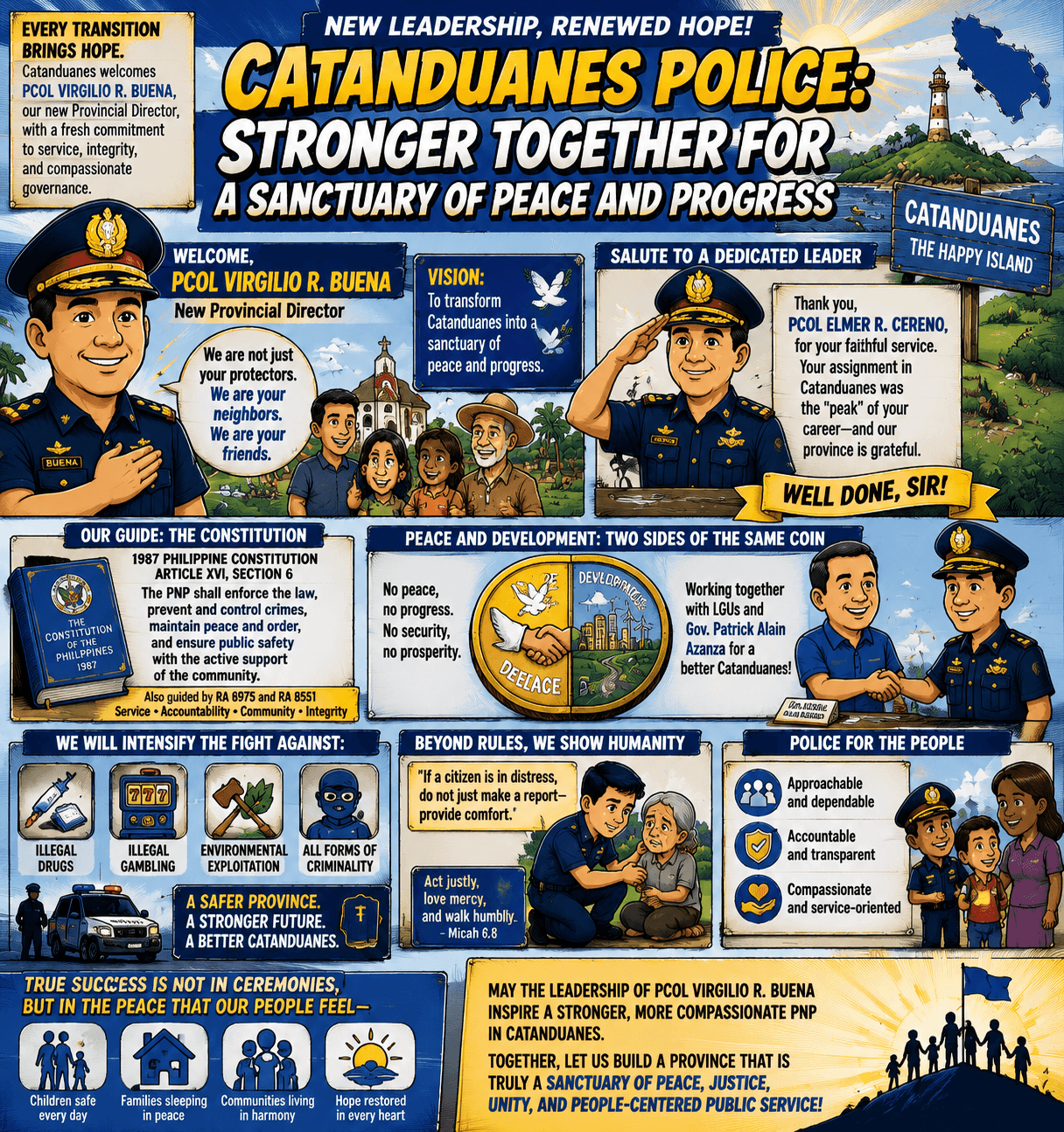
Every transition in police leadership carries with it a renewed sense of hope from the people. With the assumption of Police Colonel Virgilio R. Buena as the new Provincial Director of the Catanduanes Police Provincial Office, Catanduanes is not merely welcoming a new officer but embracing a fresh commitment to service, integrity, and compassionate governance. Coming from Iloilo City, PCOL Buena brings with him a community-oriented perspective that seeks to strengthen the relationship between the police and the people. His vision of transforming Catanduanes into a “sanctuary of peace and progress” is not simply a slogan—it is both a moral undertaking and a public responsibility.
Equally deserving of recognition is outgoing Provincial Director Police Colonel Elmer R. Cereno, whose retirement marks the end of a meaningful chapter in the history of the province’s police service. His statement that his assignment in Catanduanes represented the “peak” of his career in the Philippine National Police speaks volumes about the unique spirit of the island province. Such a declaration reflects not only his fulfillment as a police officer but also the cooperative and respectful relationship between the community and the local police force. It is rare for a retiring official to describe a post as the pinnacle of his professional life, and that alone says much about the character of Catanduanes and its people.
The mission of the Philippine National Police is deeply rooted in the 1987 Philippine Constitution, particularly Article XVI, Section 6, which mandates the police force “to enforce the law, prevent and control crimes, maintain peace and order, and ensure public safety with the active support of the community.” This constitutional mandate is reinforced by Republic Act No. 6975 and Republic Act No. 8551, which emphasize that the police organization must remain service-oriented, accountable, and community-centered. A police officer must not only carry authority but also embody discipline, humility, compassion, and moral integrity.
This is why the message of PCOL Buena resonates strongly with the public when he declared: “We are not just your protectors. We are your neighbors. We are your friends.” At a time when public trust in institutions is often tested, such words are more than ceremonial statements. They are reminders that the true strength of the police force is measured not merely by the number of operations conducted or arrests made, but by the confidence and trust it earns from the people it serves. A police force that is approachable and dependable creates a stronger foundation for peace and stability.
Catanduanes has long been known as the “Happy Island,” yet genuine happiness in a society is not measured by slogans alone. It is reflected in the safety of families, the peace of communities, and the fairness of governance. PCOL Buena’s aspiration to make the province a sanctuary of peace and progress echoes the biblical principle found in Psalm 34:14: “Turn from evil and do good; seek peace and pursue it.” Peace is never accidental. It is the product of collective effort among government leaders, law enforcers, churches, civil society, and ordinary citizens working together for the common good.
His emphasis on collaboration with local government units and people-centered governance under the administration of Governor Patrick Alain Azanza is likewise a practical recognition that development cannot flourish without security. As PCOL Buena correctly emphasized, “peace and development are two sides of the same coin.” No economy can thrive amid fear. Tourism cannot prosper where disorder exists. Communities cannot become productive when criminality and illegal activities dominate public life. Thus, the intensified campaign against illegal drugs, gambling, environmental exploitation, and other crimes is not only a police initiative but a necessary investment in the future of the province.
One of the most meaningful parts of his address was his reminder to police officers: “If a citizen is in distress, do not just make a report — provide comfort.” This statement captures the very essence of public service. Government institutions must not only be procedural; they must also be humane. A police officer who understands the suffering of the people becomes far more effective than one who merely follows rules without empathy. The biblical teaching in Micah 6:8 remains relevant to every public servant: “Act justly, love mercy, and walk humbly.” These principles should guide every law enforcer entrusted with authority.
The assumption of PCOL Buena’s leadership therefore signifies more than a change of command. It represents the continuation of a greater responsibility—to preserve public trust while firmly enforcing the law. The best police officers are not only guardians of public safety but also protectors of the dignity and credibility of government itself. When the police serve honorably, the people’s respect for institutions also grows stronger.
In the end, the success of a new police leadership will not be measured by ceremonies or public statements alone, but by the quiet peace felt in communities, the safety of children walking home, the confidence of families sleeping at night, and the hope restored among ordinary citizens. May the leadership of Police Colonel Virgilio R. Buena inspire a stronger and more compassionate Philippine National Police in Catanduanes. And may the province continue to stand not only as the “Happy Island” but as a true sanctuary of peace, justice, unity, and people-centered public service. | Rapido Commentario | Elbow Room | Richard Santiago |