











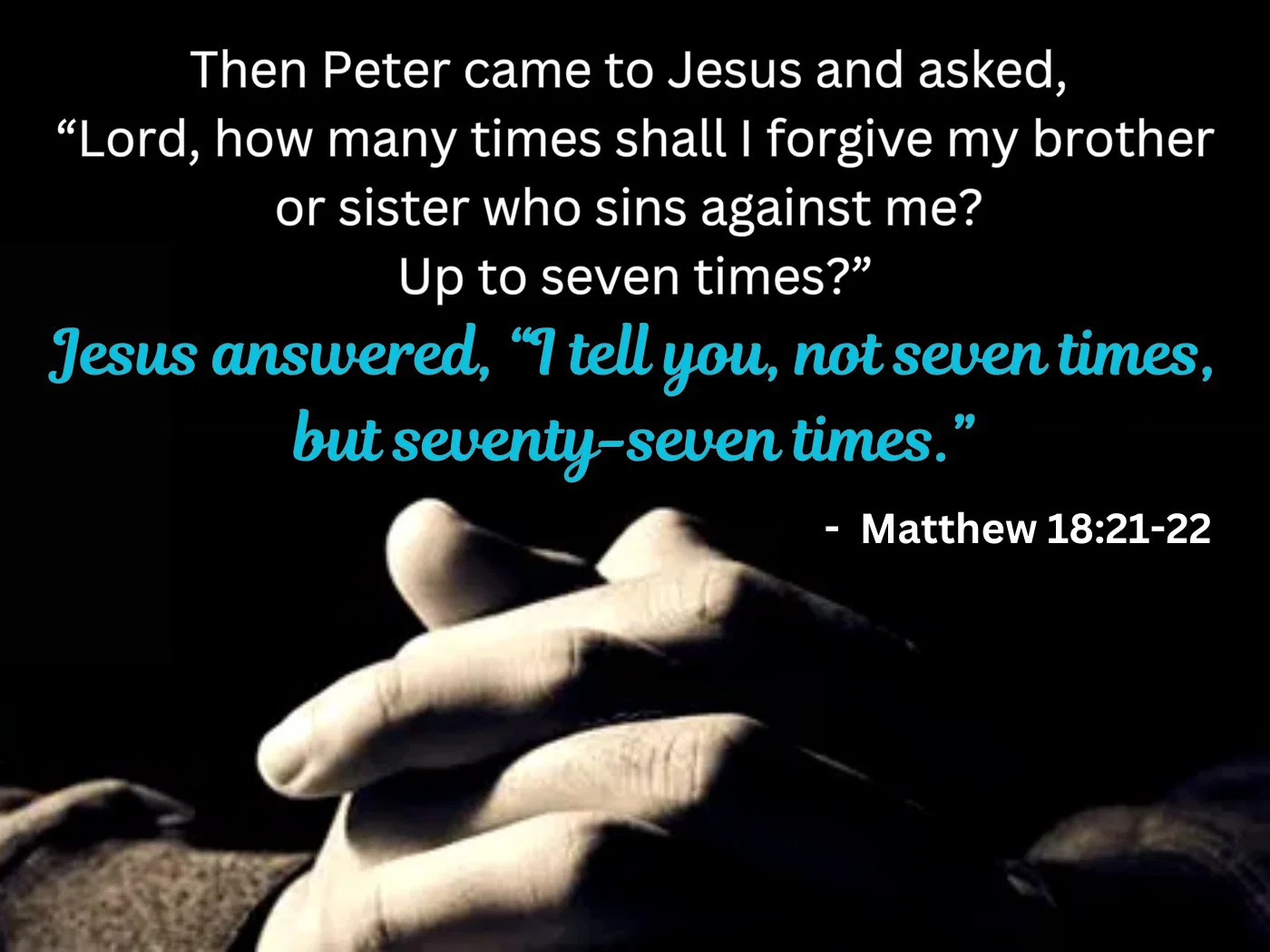
“Lord, if my brother sins against me, how often must I forgive? As many as seven times?” (Mt 18:21). This is the question Peter asks Jesus in today’s Gospel. It is also a question that many of us carry in our hearts. We may not ask it out loud, but when someone hurts us, disappoints us, betrays our trust, or wounds a member of our family, we often wonder: “How many times must I forgive? Is there a limit?”
To appreciate Jesus’ answer, we need to understand the world in which He lived. In the earliest periods of human history, vengeance was often the rule. We hear this in the words of Lamech, who boasted: “If Cain is avenged sevenfold, then Lamech seventy-sevenfold” (Gen 4:24). Revenge seemed to have no limits. Later, the Law of Moses introduced an important change. Justice replaced unlimited vengeance.
The principle known as Lex Talionis taught: “An eye for an eye and a tooth for a tooth.” While this may sound harsh to us, it actually limited revenge and prevented excessive retaliation. By the time of Jesus, the Jewish people had already grown in their understanding of mercy. Influenced by the prophets, they practiced forgiveness, often up to three times. A person who forgave repeatedly was considered holy and generous.
That is why Peter probably thought he was being extraordinarily charitable when he suggested forgiving seven times. He more than doubled the accepted standard. Yet Jesus responds: “I say to you, not seven times but seventy-seven times” (Mt 18:22). Jesus is not giving us a number to count. He is not suggesting that after the seventy-seventh offense we are free to stop forgiving. Rather, He is teaching that Christian forgiveness has no limits. Just as Lamech made revenge unlimited, Jesus makes mercy unlimited. He completely reverses the cycle of vengeance and replaces it with the power of love and forgiveness.
Brothers and sisters, this is at the heart of the Christian life. We forgive because we ourselves have been forgiven. Every time we come before God with sincere repentance, He welcomes us with mercy. He does not keep a record of our sins. He does not remind us of every failure. Instead, He forgives us again and again, especially through the beautiful Sacrament of Reconciliation.
In fact, every time we pray the Lord’s Prayer, we say: “Forgive us our trespasses as we forgive those who trespass against us.” These are powerful words. We are asking God to treat us in the same way that we treat others. If we desire God’s mercy, then we must also be willing to extend mercy to those who have hurt us.
The parable in today’s Gospel helps us understand why forgiveness is often so difficult. The servant owed the king an enormous debt, one that he could never repay. Yet when he begged for mercy, the king forgave everything. It was an act of astonishing compassion.
However, that same servant refused to forgive a fellow servant who owed him a much smaller amount. Instead of showing mercy, he demanded payment and had the man thrown into prison. What was his problem? He forgot that he himself had been forgiven. He forgot the mercy he had received.
Isn’t that sometimes our problem as well? Like the servant, we are all debtors before God. We are not perfect. We have sinned. We have failed. We have hurt others and have often fallen short of God’s expectations. Yet God continues to forgive us. The tragedy is that we sometimes receive His mercy but fail to pass that mercy on to others.
When we refuse to forgive, we may think we are hurting the other person, but often we are the ones who suffer the most. Resentment steals our peace. Anger burdens our hearts. Old wounds remain open. We carry around pain that God wants to heal. Forgiveness does not mean pretending that the hurt never happened. It does not mean that what was done was acceptable. Rather, forgiveness means placing the wound into God’s hands and refusing to let bitterness control our lives. It means allowing God’s grace to be stronger than our hurt.
Perhaps today there is someone in our life whom we find difficult to forgive. It may be a family member, a friend, a coworker, a former spouse, or even someone who has already passed away. Perhaps the wound is fresh, or perhaps we have carried it for many years. Jesus looks at each of us today and gently says: “Forgive from your heart.” This is not easy. In fact, it may be one of the hardest things Jesus asks of us.
Forgiving can take time. Sometimes it is a process rather than a single moment. But with God’s grace, it is possible. The Gospel challenges us not merely to call ourselves Christians but to live as genuine Christians. A true Christian is not identified simply by attending Mass, saying prayers, or carrying a rosary. A true Christian is someone who learns to love, to show mercy, and to forgive as Jesus forgives.
As we continue this Holy Eucharist, let us bring before the Lord the names and faces of those who have hurt us. Let us ask Him for the grace to release whatever resentment we carry in our hearts. And let us pray that, having received God’s infinite mercy, we may become instruments of that same mercy for others.
May the Blessed Virgin Mary and Saint Joseph intercede for us, that God may grant us the courage to forgive from the heart, the humility to seek forgiveness when we have offended others, and the grace to live as true sons and daughters of our merciful Father. Amen.