












The move to withdraw the “persona non grata” declaration against Gov. Patrick Alain Azanza is far more than a symbolic legislative action. It is a political statement that signals a possible shift in the power dynamics and governance climate in Catanduanes. After months of open conflict between the executive and legislative branches, the resolution now being pushed inside the Sangguniang Panlalawigan appears to acknowledge an uncomfortable reality: prolonged political warfare has already begun affecting the province itself.
For a long time, the people of Catanduanes witnessed political hostilities dominate public discourse. Instead of governance taking center stage, the provincial political atmosphere became consumed by accusations, counter-statements, media attacks, and institutional confrontation. The capitol gradually evolved into a battlefield of competing political interests rather than a unified center of public service. In that environment, development naturally slowed, coordination weakened, and public confidence suffered.
This is why the proposed withdrawal of the declaration carries significant political weight. Whether openly admitted or not, it reflects an understanding among some leaders that continuous escalation benefits no one. More importantly, it suggests that certain sectors within the provincial government may now be reconsidering the cost of division, especially at a time when the province is facing serious concerns involving energy issues, infrastructure needs, economic pressures, disaster preparedness, and social services.
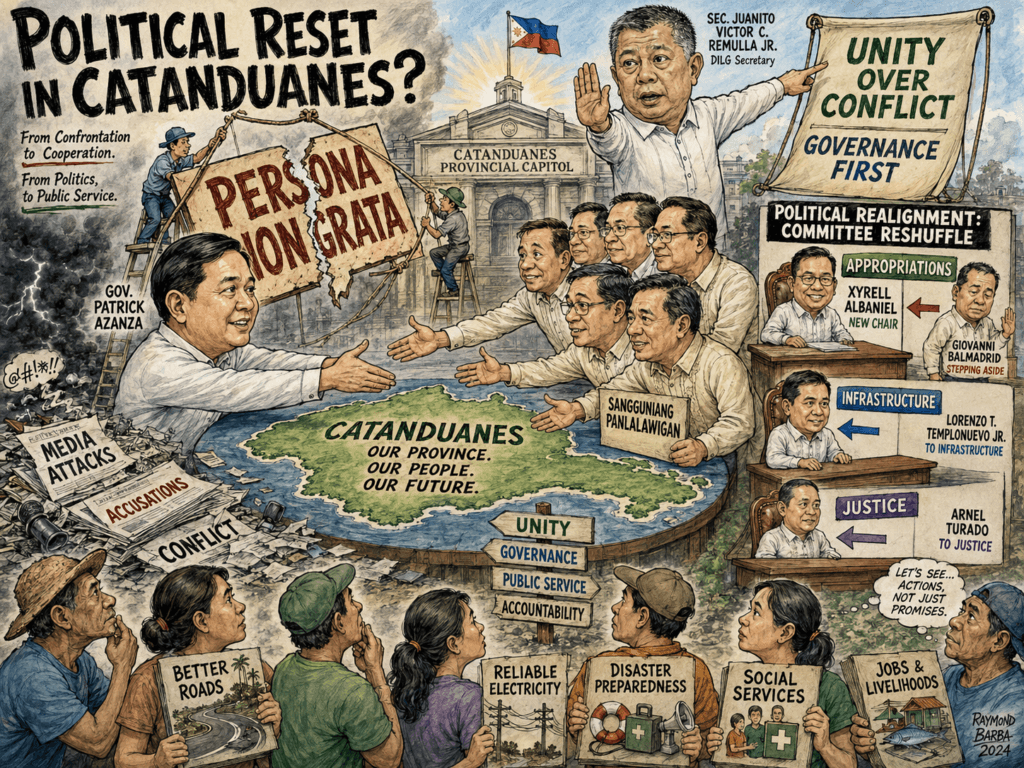
The timing of the move also cannot be ignored. Many observers believe the development is closely connected to the earlier appeal made by Juanito Victor C. Remulla Jr. during his visit to Catanduanes on April 28, 2026. The DILG Secretary’s message was direct and difficult to misinterpret: local leaders must prioritize governance over political conflict. His call for unity, institutional cooperation, and political maturity now appears to be slowly resonating within the provincial leadership.
Equally significant is the reshuffling of committee chairmanships inside the Sangguniang Panlalawigan, particularly the reassignment involving the Committee on Appropriations. In legislative politics, the Appropriations Committee is among the most influential committees because it directly handles budgetary priorities, allocation of resources, and fiscal direction. Changing its leadership is never a minor administrative matter. It is often interpreted as a strategic recalibration of political alliances and legislative control.
The appointment of Xyrell Albaniel as the new chair of the Committee on Appropriations, replacing Giovanni Balmadrid, sends a strong political signal. Likewise, the reassignment of Lorenzo T. Templonuevo Jr. to the Infrastructure Committee and Arnel Turado to the Justice Committee indicates that the legislative body may be reorganizing its internal structure to reduce friction and restore operational stability. These are not random decisions; they reflect deeper political calculations aimed at restoring functionality inside the provincial government.
Still, reconciliation in politics is never guaranteed simply because tensions temporarily decline. The political wounds created by months of confrontation, public criticism, and institutional conflict cannot be erased overnight. Adding to the uncertainty are the pending cases before the Ombudsman involving both sides, which may still result in suspensions or legal consequences. This means that while the present developments are encouraging, the possibility of renewed conflict remains very real.
However, even a temporary political de-escalation can already benefit the province if it leads to better communication, smoother coordination, and faster government action. The people of Catanduanes are less concerned about political victories and more concerned about whether roads are built, electricity problems are addressed, disaster programs are strengthened, and public services improve. Governance cannot function effectively when leaders are consumed by personal and political battles.
In the end, the true measure of reconciliation will not be speeches, resolutions, or committee reshuffles. It will be seen in whether the provincial government becomes more stable, more cooperative, and more responsive to public needs. Political maturity is tested not during moments of alliance, but during moments when leaders choose to place the welfare of the province above personal pride and political ambition. For Catanduanes, this may finally be the moment where leadership is measured not by conflict, but by the ability to restore unity for the common good. | By: SM Ferdz Brizo | FB Eye | Weekly Column | Bicol Peryodiko newspaper | Catanduanes