












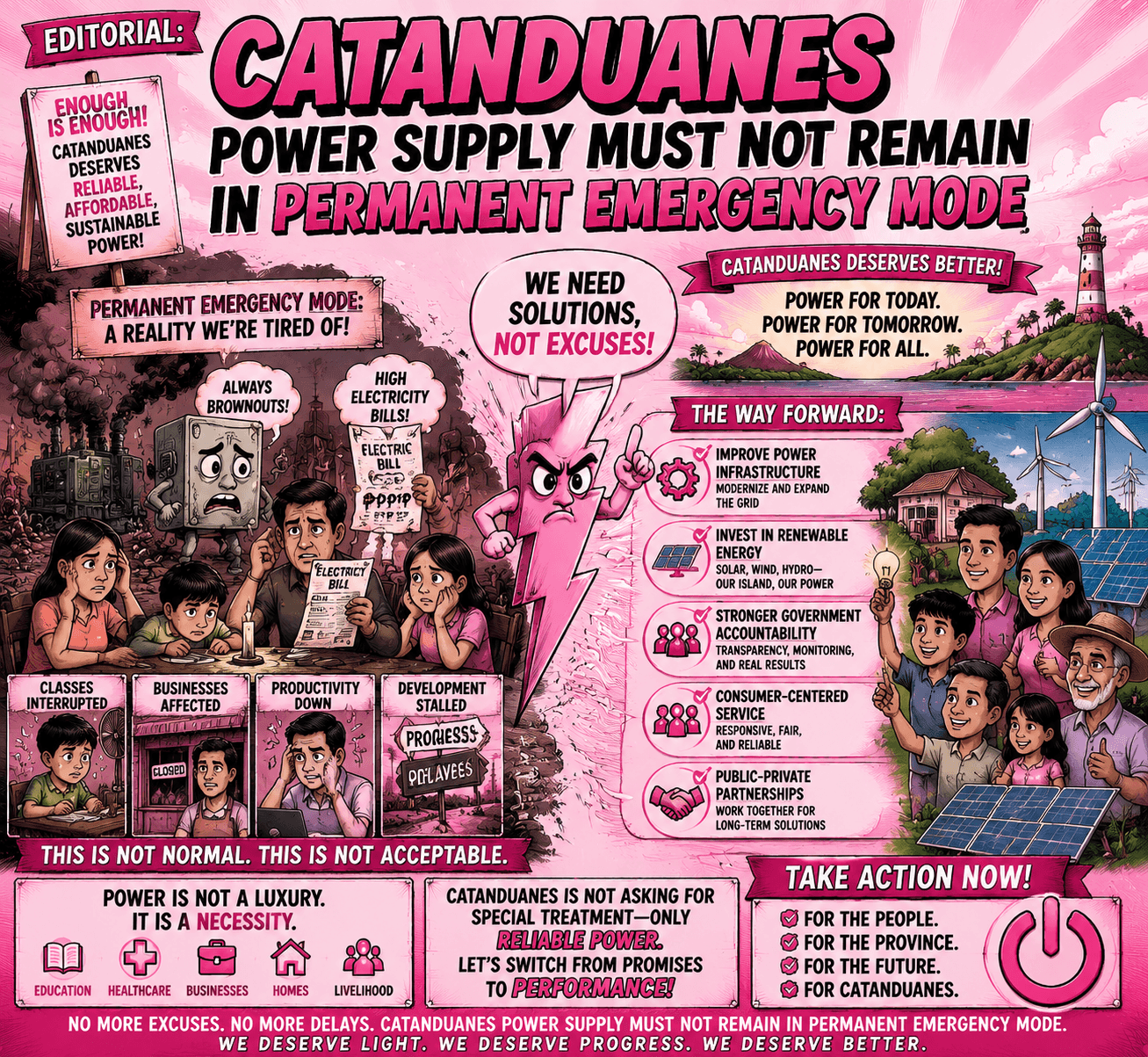
The possible power supply gap in Catanduanes during FICELCO’s transition to a new Independent Power Producer is not a minor operational inconvenience. It is a serious warning. If a province repeatedly depends on Emergency Power Supply Agreements, then the problem is no longer just emergency procurement. It is weak long-term energy planning. Electricity is not a luxury item. It powers hospitals, schools, homes, small businesses, water systems, communication lines, and disaster response. When electricity fails, the cost is carried not by officials in boardrooms, but by families, workers, students, patients, and entrepreneurs.
Under Republic Act No. 9136, or the Electric Power Industry Reform Act of 2001, the State policy is to ensure the quality, reliability, security, and affordability of electric power supply. That legal standard must be the minimum expectation from FICELCO and all concerned energy actors. The public should not be asked to simply “understand” possible brownouts without seeing a concrete, transparent, and legally sound transition plan. Reliability is not a slogan. It is a legal and public-service obligation.
This is where the FICELCO Board must act with urgency and seriousness. It should not merely wait for available bidders to appear. It must actively search, engage, and attract reliable suppliers with proven technical capacity, stable financial standing, transparent pricing, and actual experience in island-grid operations. In plain terms, the Board must make heaven and earth to secure a supplier that can serve Catanduanes not only during summer, not only during transition periods, but throughout the year. A power cooperative cannot afford passive procurement when the entire island’s economic life depends on it.
The Board must also stop treating renewable energy as a side conversation. Republic Act No. 9513, or the Renewable Energy Act of 2008, establishes the national framework for the accelerated development and increased utilization of renewable energy resources. This gives FICELCO a clear policy basis to seriously pursue solar, wind, hydro, biomass, hybrid generation, and battery energy storage where technically feasible. Renewable energy should not be considered only when fuel prices rise or brownouts loom. It should be part of a deliberate energy security strategy for Catanduanes.
The delayed Competitive Selection Process also deserves public scrutiny. DOE rules require distribution utilities to undergo Competitive Selection Process in securing power supply agreements, precisely to promote transparency, competition, and better pricing for captive consumers. If the long-term CSP was delayed because of technical and regulatory requirements, FICELCO must clearly explain what caused the delay, what has already been done, what remains pending, and when the process will be completed. The consumers are not outsiders. They are the ones paying the bills.
The role of the Energy Regulatory Commission is also crucial. The ERC was created under Section 38 of EPIRA as an independent, quasi-judicial regulatory body. Its approval process is not a formality; it is part of consumer protection and rate regulation. But while regulatory approval must be respected, FICELCO should not use pending ERC approval as a blanket explanation for uncertainty. The cooperative must prepare bridge measures, realistic timelines, demand-management plans, and public advisories so the transition does not become a guessing game for consumers.
The recommendation is clear: FICELCO must immediately publish a transition roadmap covering the end of EPSA 1, the status of EPSA 2, the expected ERC approval timeline, the mobilization period of the new provider, and the exact contingency plan if supply becomes insufficient. Second, it must conduct broader supplier engagement, especially with companies capable of offering renewable and hybrid solutions. Third, it must accelerate the long-term CSP without sacrificing legal compliance. Fourth, it must study battery storage and distributed renewable generation as part of a multi-year island energy plan. Fifth, it must issue regular public updates so consumers are not left relying on rumors and fear.
Rotational brownout may be used as a last-resort temporary measure, but it must never be normalized as the province’s default answer to poor planning. Catanduanes deserves more than emergency contracts and last-minute explanations. It deserves a power strategy that is reliable, affordable, transparent, and future-ready. The real test for FICELCO is not whether it can survive another transition. The real test is whether it can finally move Catanduanes away from emergency mode and toward genuine energy security. | Editorial | Bicol Peryodiko |