













The recent decision of Catanduanes representatives—Eulogio Rodriguez and Jose Teves Jr.—to support the impeachment complaint against Vice President Sara Duterte has intensified both national debate and local division in Catanduanes. For some, it is a principled act rooted in constitutional duty. For others, it is an unmistakable sign of political alignment in a deeply polarized national landscape. The real question, however, is not merely who voted yes, but whether the impeachment process itself is being driven more by constitutional fidelity or political strategy.
Under Article XI of the 1987 Constitution on Accountability of Public Officers, impeachment is not designed as a political weapon but as a constitutional safeguard. It exists to ensure that high-ranking officials may be held accountable for grave offenses such as betrayal of public trust, culpable violation of the Constitution, graft and corruption, or other high crimes. The threshold requirement—at least one-third of all members of the House of Representatives—serves as a preliminary screening mechanism, not a determination of guilt. In this sense, the affirmative vote of the two Catanduanes lawmakers does not convict the Vice President; it merely allows the process to proceed to the Senate, which functions as the impeachment court.
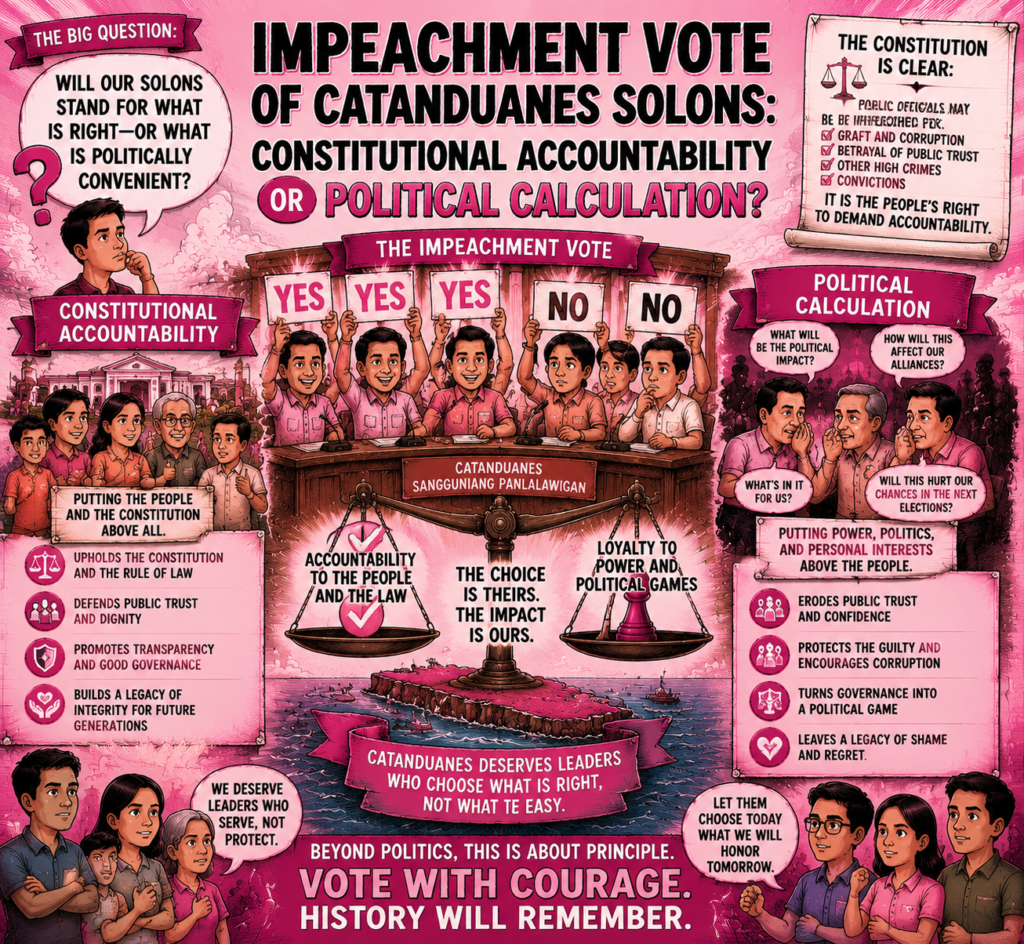
From a strict constitutional perspective, their vote can be defended as compliance with institutional responsibility. Legislators are not required to conduct a judicial trial at the House level; they are tasked only to determine whether the allegations are sufficient in form and substance to warrant full trial. If viewed through this lens, supporting the Articles of Impeachment may be interpreted as an affirmation of due process rather than a declaration of political hostility.
However, impeachment in the Philippines has rarely been insulated from politics. Historically, it has often reflected the shifting alliances within Congress and broader struggles among political blocs. This reality inevitably casts doubt on whether such votes are purely legal judgments or also influenced by political positioning. The timing of the impeachment proceedings, coupled with changes in Senate leadership and evolving national alliances, further fuels suspicion that the process is not entirely immune from strategic calculations.
This is where the distinction between legality and perceived legitimacy becomes crucial. An act may be constitutionally valid yet still be perceived as politically motivated. That perception matters, because impeachment is not only a legal mechanism—it is also a political process that relies heavily on public trust. When citizens begin to see impeachment as a tool of convenience rather than accountability, the credibility of democratic institutions is weakened, regardless of legal correctness.
For the Catanduanes solons, their decision places them within this tension between duty and perception. On one hand, they are expected to uphold the Constitution without fear or favor. On the other hand, they inevitably operate within a political ecosystem where loyalty, coalition-building, and national alignment influence legislative behavior. Whether their vote is interpreted as statesmanship or political conformity will depend largely on how the Senate trial unfolds and whether evidence—not influence—ultimately drives the outcome.
The Senate, acting as an impeachment court, now carries the heavier burden. Its responsibility is to rise above partisan divisions and function as an impartial constitutional tribunal. If it fails to do so, the impeachment process risks being reduced to political theater rather than a genuine accountability mechanism. That would be a disservice not only to the accused Vice President but also to the integrity of the Constitution itself.
In conclusion, the Catanduanes lawmakers’ support for impeachment can be defended as constitutionally grounded, but it cannot be entirely separated from the broader political environment in which it occurred. It is both a legal act and a political signal. Whether it will be remembered as a courageous affirmation of accountability or as a maneuver within partisan struggle will ultimately depend on the fairness, rigor, and independence of the Senate trial that follows. | FB Eye | Ferdie Brizo | Bicol Peryodiko Weekly